
Video Summary — LAR Palasio episode with Francisco de Armas 🎬🇵🇷
Episode topic
- How Puerto Rico instrumentalities and municipalities can access capital via the Puerto Rico Municipal Financing Fund (PRMF) — interview with Francisco de Armas, owner of PRMF.
Key people
- Host (LAR Palasio)
- Guest: Francisco de Armas — owner, Puerto Rico Municipal Financing Fund; background: CPA → law → finance; experience in distressed commercial debt and public debt servicing.
Background / Problem
- 2018: Government Development Bank (GDB) ceased during restructuring → gap in municipal financing.
- Banks consolidated post-2008 and post-Section 936 phase-out, reducing local liquidity.
- General narrative: “Puerto Rico debt = bad” but credits differ by structure, payment source, pledges.
Opportunity & Idea
- PRMF created to fill a niche: provide buy-side private capital for municipal and instrumentalities’ debt using a fund structure (Act 60 benefits).
- Insight came from servicing distressed commercial loans and later monetizing assets tied to GDB successor (Debt Recovery/Reorganization processes).
- Identified a strong municipal credit type: special additional property tax (CRIM special additional tax) pledged to pay municipal debt.
Key transaction (San Juan)
- PRMF part of team enabling an investment-grade municipal transaction (first in Puerto Rico in over a decade).
- Approximate figures discussed:
- ~ $220M facility to refinance/refund.
- ~ $123M new money for municipal projects.
- ~108 bps interest reduction vs old debt; large projected interest savings.
- Local banks handled reprofiling/refinancing; PRMF provided new-money portion and fund structure.
- Rating agencies assigned investment grade — signals credit-specific strength can differ from sovereign narrative.
Why the CRIM special additional tax credit is strong
- Structure: municipalities set special tax; CRIM (central tax collector) segregates collections into a general trust.
- Statutory pledge to lenders; debt service prioritized (scheduled payments, coverage reserve = 1 year).
- Trustee moved from GDB to private bank (reduces central-government commingling risk).
- Historically paid on time — uncommon among Puerto Rico public debt.
What PRMF adds / differentiation
- Uses Act 60 fund tax incentives to attract private investment into municipal credits.
- Matches bond amortization to asset useful life (longer-term bonds vs short commercial loans).
- Focus on mid/small creatively structured municipal and private-activity credits (health, energy, infrastructure, education).
- Niche between large investment banks and local banks — offers tailored financing solutions and tax-driven investor incentives.
Act 60 (fund tax incentives) — concise points
- Encourages private capital deployment into eligible investments (including government-issued debt).
- Offers tax deductions/incentives to funds investing in Puerto Rico projects/credits.
- Helps retain financial services, talent, and fund operations in Puerto Rico; can make Puerto Rico an exportable finance platform under US federal regulations.
Challenges & Execution lessons
- First-time direct municipal market access (municipalities historically used GDB): process complexity and discipline in fiscal governance required.
- Need for RFPs, statutory/regulatory compliance, trustee arrangements, and coordination with rating agencies.
- Importance of demonstrating credit-level differentiation to overcome sovereign stigma.
Outlook / Why Francisco is hopeful ✅
- Municipal market (US muni market ~ $4T) offers diverse credit types and opportunities.
- PRMF can expand to private activity munis and sector-specific financing (energy, health, education).
- Improved access to capital can fund infrastructure and maintenance, reversing liquidity-driven neglect.
- Successful transactions can open repeated market access for other municipalities and instrumentalities.
Actionable takeaways (for municipalities / investors) 🛠️
- Municipalities can access markets directly if they:
- Structure payments via statutory pledges (e.g., CRIM special additional tax).
- Maintain fiscal discipline and required reserves/coverage.
- Run proper RFP processes and engage rating agencies.
- Investors can participate via Act 60-qualified funds to obtain tax-advantaged exposure to municipal credits.
- Local banks, private funds, and underwriters can collaborate: banks provide restructuring/reprofiling; funds provide buy-side capital; underwriters manage market placement.
Notable quotes / moments
- PRMF’s approach: “segregate credit from sovereign narrative — analyze structure, payment source, and pledges.”
- Host: first investment-grade municipal deal in Puerto Rico in over a decade — a market-restart signal.
Overall significance
- Demonstrates a replicable model: combine strong credit structures (CRIM special additional tax), private fund capital (Act 60 incentives), and market discipline to restore municipal access to capital markets in Puerto Rico.
- Potential to catalyze broader municipal financing, infrastructure investment, and growth of Puerto Rico’s financial services ecosystem.
📬 Never miss a Raúl Palacios video — every new upload summarised in your inbox.
Follow free
Other summaries of this video
More from Raúl Palacios
 Ella Woger, CEO de Invest Puerto Rico, revela el plan para desarrollar la economía de PR
 Francisco De Armas (PRMF): El camino de regreso a los mercados de capital para los municipios de PR
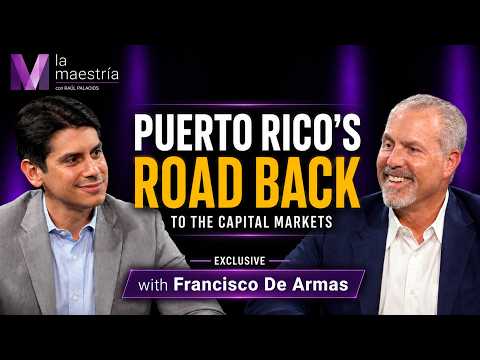 Francisco De Armas (PRMF): The Road Back to the Capital Markets for Puerto Rico's Municipalities
 La evolución de Parallel 18 con Dr. Héctor Jirau
 La Maestri Live Panel IA
 La Maestria 7 22 2026 AIR
 La Maestria 8 12 2026 AIR
 La Maestria 8 19 2026 AIR
 La Maestria Al Dia 3 20 2026 AIR
 La Maestria Al Dia 4 1 2026 AIR
 La Maestria Al Dia 5 20 2026 AIR