
Commodities Trading from First Principles
Core Principle: Supply, Demand, and Inventory
The central equation for commodities trading is:
Supply − demand = change in inventory
- When supply exceeds demand, inventories build and prices generally fall.
- When demand exceeds supply, inventories draw down and prices generally rise.
- Storage provides a buffer—but when it is full or empty, price must do most of the work to balance the market.
- The 2020 crude oil price collapse illustrates this: prices went negative as buyers faced a lack of available storage and uncertainty about taking delivery.
How Energy Markets Differ
Energy is a fundamental input to transportation, manufacturing, farming, and power generation, so price changes ripple across the economy.
Different energy sources vary in how easily they can be stored:
- Coal: Relatively easy to stockpile.
- Oil: Stored in tanks and transported by pipeline or ship.
- Natural gas: Stored under pressure, often underground, and transported through pipelines.
- Electricity: Difficult to store at scale and generally must be used as it is produced, though batteries and pumped hydro are expanding storage options.
Natural gas demand and storage patterns are especially seasonal: gas is typically injected into storage during summer and withdrawn during winter.
Why U.S. Natural Gas Is So Volatile
- In the short term, natural gas demand is highly inelastic: households still need heat during extreme cold.
- Weather can quickly shift demand, producing sharp price moves.
- Storage is finite, so there is limited capacity to absorb either a surplus or a shortfall.
- Pipeline constraints can cause regional prices to diverge sharply, even when the Henry Hub benchmark is well supplied.
Henry Hub and Basis
Henry Hub is the central U.S. natural gas futures benchmark. Its physical delivery mechanism helps connect futures prices to the real market: traders can arbitrage differences between storage costs and futures prices.
However, Henry Hub is in Louisiana, while gas is consumed across the country. Basis markets capture the price difference between Henry Hub and regional locations. When pipelines are congested or local demand surges, regional prices can move independently.
What Drives Natural Gas Supply and Demand
Supply
Horizontal drilling and hydraulic fracturing enabled producers to access much larger volumes of shale gas. The resulting supply growth helped lower U.S. gas prices and made gas-fired power competitive with coal. Much natural gas is also produced alongside crude oil.
The speaker argues that U.S. gas production is often constrained more by pipeline capacity than by geology.
Demand
- Industrial demand has historically been relatively steady, though manufacturing growth may increase it.
- Residential and commercial demand mainly reflects heating and cooling.
- Gas-fired power generation rises when electricity demand increases, such as during hot weather.
- LNG exports connect U.S. gas to global markets. Expanding export capacity could affect U.S., European, and Asian gas prices.
- Data-center electricity demand is a major uncertainty and could become an important source of new gas demand.
Trading Framework
The speaker describes trading as a sequence of four decisions:
- Generate an idea: Form a view based on supply, demand, inventories, and other market conditions.
- Choose how to express it: Select the appropriate instrument—such as futures, options, spreads, or related equities.
- Execute the trade: Decide how and when to build the position, including whether to scale in.
- Manage the position: Assess risk both when the trade is losing and when it is working.
A key challenge is knowing when to reduce a profitable position. Traders should keep reassessing whether the original thesis still holds, how the risk-reward has changed, and whether there are still buyers for the position.
Silver Trade: Lessons in Conviction and Risk
The speaker’s silver example shows how a market can remain tight without immediately rising:
- Silver had experienced repeated supply deficits, including when investment demand was considered.
- Supply is partly a byproduct of mining other metals, so it may not respond quickly to higher prices.
- Demand comes from industry—including solar panels and electronics—as well as jewelry and investment.
- The gold-to-silver ratio was historically high, supporting the case for silver potentially catching up.
The speaker built a position with futures and inexpensive call options, scaling in as the market confirmed the view. However, he says he failed to reassess his bullishness as prices rose sharply, and a sudden selloff exposed that risk. A strong thesis does not remove the need to manage a winning trade.
Market Trends and Takeaways
- Never assume you are bigger than the market. Oversized positions can create catastrophic losses, as illustrated by the Amaranth trading collapse.
- Solar growth can depress midday power prices, creating the “duck curve”; batteries and other storage may reshape this pattern.
- LNG exports are expanding, raising questions about whether supply, pipelines, and global demand can keep pace.
- Derivatives trading is increasingly automated, while physical commodity trading remains valuable because it requires understanding contracts, pipelines, logistics, and embedded optionality.
- Trading firms increasingly specialize either in very short-term, speed-sensitive strategies or in much longer-term investing.
Closing Advice
A mentor’s advice to the speaker was: “If you can leave Wall Street with your name intact and your house paid for, you’re ahead of 90% of the people who go there.” The point is to protect your reputation, avoid dishonest or reckless opportunities, and treat your name as your most important asset.
Other summaries of this video
More from Odds on Open
 Ex-Goldman Oil Derivatives Trader: Every Trading Strategy Is Momentum or Mean Reversion
 Hedge Fund Manager David Orr: Investing is 99% Talent
 Hedge Fund Manager Joseph Walsh: Always Play Weaker Players
 LTCM Co-founder Victor Hagani: “Taking Risk Is Always a Negative.”
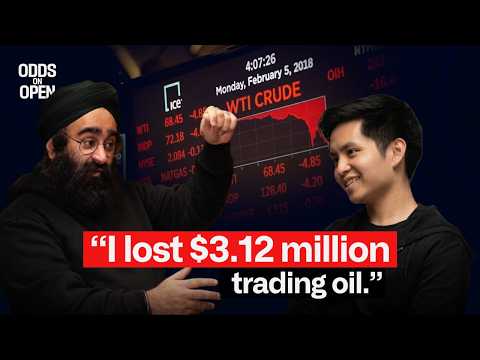
 Welcome to Gas Vegas: Commodities Trading From First Principles With Ex-Goldman Commodities Trader