Executive Brief
Build mission-driven startups that users love.
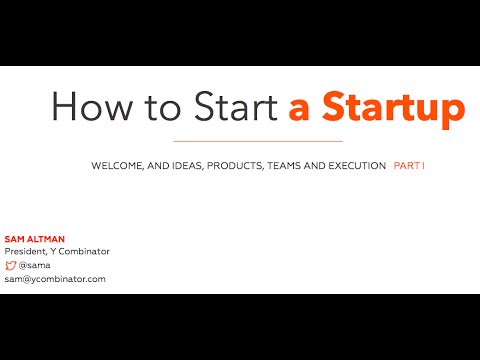
Speaker: Sam Altman (President, Y Combinator); Dustin Moskovitz (Co‑founder, Facebook & Asana)
Summary: Sam Altman argues that startup success depends on excelling at four controllable factors—idea, product, team, execution—plus luck, with special emphasis that a strong, defensible, mission‑oriented idea and an obsessive focus on building a product a small group of users love are the highest‑leverage priorities. Dustin Moskovitz adds that you should start a company only if you "can't not" do it: you are passionate, the world needs it, and you are uniquely positioned to execute, while recognizing the intense stress and commitment entrepreneurship requires.
- A great idea matters. Spend real time choosing an idea with market growth, defensibility, and expansion potential; a bad idea cannot be saved by execution alone.
- Prefer mission‑oriented ideas. Missions motivate founders, recruit help, sustain ten‑year efforts, and compel extreme team focus and productivity.
- Start small to win big. Target a narrow market where you can achieve local monopoly, then expand—ideas that look small or bad at first can scale into monopolies.
- Unpopular but right beats obvious. If most people think your idea is bad, that’s often an advantage: fewer competitors and validation that you’ve found an under‑served opportunity.
- Think "why now". Prefer markets with strong tailwinds and rapid future growth rather than large but stagnant markets.
- Build a product users love. Prioritize turning your idea into something a small number of users intensely love before worrying about growth channels or PR.
- Choose depth over breadth early. It’s easier to expand from a product loved by few than to convert lukewarm mass interest into passionate adoption.
- Iterate with a tight feedback loop. Recruit early users manually, listen obsessively, ship rapid weekly improvements, and embed continuous user feedback into company culture.
- Be fanatical about quality and details. Founders must personally care about copy, UX, support, and fix problems quickly—don’t ship mediocre experiences.
- Do things that don't scale initially. Manual recruitment and hands‑on support create the foundational love and word‑of‑mouth growth you’ll later scale.
- Measure the right metrics. Track active usage, retention cohorts, engagement and NPS—ignore vanity stats like total registrations.
- Founders must stay close to users. Don’t insert layers between founders and customers; early sales/support work is founder work to learn and iterate.
- Team and execution matter. Idea × Product × Team × Execution × Luck determines outcomes; execution is harder and more crucial than ideas but can’t substitute for a poor idea.
- Meet co‑founders early. College and formative networks are prime places to find committed co‑founders—relationships matter more than early product choices.
- Know why you’re starting. Common motivations (glamour, boss status, more equity) are insufficient; the best reason is you can’t stop working on the problem and the world needs your solution.
- Expect stress and long commitment. Entrepreneurship is psychologically demanding, always on call, and often longer and harder than imagined—manage health and mindset deliberately.
📬 Never miss a YC Root Access video — every new upload summarized in your inbox.
Follow free