The 2020 Oil Price Crash
- In April 2020, the COVID-19 pandemic sharply reduced oil demand while Russia and Saudi Arabia were in a price war.
- Storage was running out, and landlocked U.S. WTI crude had nowhere to go. The expiring futures contract settled at –$37.63 per barrel, the first negative oil price in history.
- This broke standard options models, which assumed prices could not fall below zero. The trader and his team had to reassess risk and P&L, consult quantitative analysts, check broker-market prices, and use conservative assumptions.
- The exchange had recently allowed negative-strike options and shifted its margining approach toward a normal distribution, which can accommodate negative prices. Markets gradually stabilized and recovered later in 2020 and early 2021.
How Oil Derivatives Trading Works
- The desk primarily made money by facilitating client trades, especially hedges from oil producers. The guest estimated producers accounted for 80–85% of the desk’s flow.
- Banks also structured bespoke products, such as swaptions—options to enter forward-starting swaps—and earned compensation for providing liquidity and holding risks that could not be perfectly hedged.
- Oil derivatives ultimately relate to physical oil. Information about cargoes, shipping costs, producers, and the spot market can help explain market prices.
- A dealer cannot eliminate every risk. It earns compensation for risks such as bid–offer spreads and basis risk between a bespoke client trade and the liquid instruments used to hedge it.
- Producer “three-way” hedges illustrate how market risk can become credit and financing risk: a sharp price move can leave producers needing cash and choosing to unwind hedges, even when those hedges are valuable.
Trading Principles and Risk
- The guest argues that most trading strategies can be understood as momentum—expecting a trend to continue—or mean reversion—expecting prices to return toward a reference value.
- Two desirable trade setups are “my size, your price” (strong conviction justifies accepting the price) and “your size, my price” (a counterparty’s need to trade size can justify a favorable price).
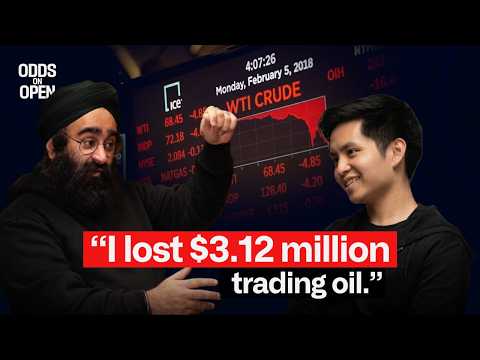
- A trade can be fundamentally sound and still fail if the trader cannot withstand the mark-to-market swings. The guest recalled losing $3.12 million in one day, partly because of market moves, operational issues, and DeFi activity targeting positions.
- Moving from market making to taking risk requires a different mindset: market makers focus on quoting and managing flow; speculators must weigh conviction against transaction costs and market impact.
Moving from Goldman to Crypto
- The guest joined crypto market maker GSR, viewing digital assets as an opportunity to help reshape market infrastructure, with a relatively attractive downside if the sector did not develop as expected.
- His work included:
- Designing structured products and yield strategies, including covered-call approaches.
- Institutional and OTC sales, helping clients with risk management and revenue diversification.
- Building a proprietary trading group from scratch.
- Leading DeFi trading, including cross-venue arbitrage and on-chain strategies.
- One example of a crypto strategy was the funding trade: buy an asset such as Bitcoin in spot markets and short its perpetual future to earn funding when demand for leveraged longs makes funding positive. It can be profitable but requires substantial capital and margin.
- Another approach was a quality trade: go long more established, liquid assets and short a basket of weaker, long-tail assets. The challenge is surviving sharp, idiosyncratic rallies in assets being shorted.
- On-chain data reveals trading activity and positions, creating opportunities for analysis but also risks such as front-running and other forms of MEV.
Market Outlook and Learning to Trade
- The guest sees potential in markets tied to AI infrastructure, especially power and energy, where hedging and trading markets remain relatively opaque.
- He believes AI tools can help traders test more ideas and process more information, but they do not supply “alpha” automatically. Results depend on the quality of the data, reasoning, and research being fed into them.
- His suggested starting point is to ask why people trade: to speculate, hedge, or provide a service such as market making. Then identify what drives a market, where inefficiencies may exist, and which instrument best expresses the resulting view.
Monaco Exchange
- The guest is building Monaco Exchange, aiming to expand access to existing and new markets, including markets that are difficult for retail traders to reach.
- The project’s market-listing model is designed to be trader-driven:
- Active users build an activity score through trading.
- Eligible users can propose markets and state how much trading activity they expect to bring.
- Proposals can be co-sponsored; Monaco evaluates demand and works with market makers and data providers.
- Proposers who deliver their promised activity can receive a share of taker-fee revenue while the market remains listed.
- Users who fail to deliver have their activity score reduced.
- The goal is to avoid relying on large listing fees or requiring users to lock up a token to propose markets.
- The guest identified power and compute as promising potential markets, alongside more conventional instruments. For example, orange juice futures already trade on ICE; onion futures are prohibited in the U.S. after an attempt to corner the market in the 1950s.
- He described Monaco’s intended users as traders and portfolio-minded participants who want 24/7 access, long–short strategies, or programmatic trading through APIs. The exchange was approaching its mainnet launch at the time of the interview.
- His long-term ambition is to build a small, focused team and an exchange that supports more markets and broader institutional access.
📬 Never miss a Odds on Open video — every new upload summarized in your inbox.
Follow free