AI and the Future of Mathematics
The moment and its impact
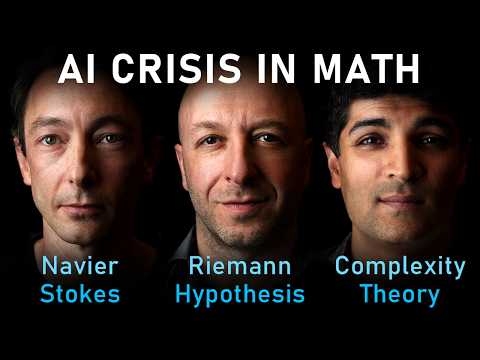
- Recent AI systems have produced and formally verified proofs of major mathematical results, including work on the Navier–Stokes equations, the Unique Games Conjecture, and a result related to the Riemann hypothesis. The discussion also highlights a striking formal proof of Fermat’s Last Theorem.
- The mathematicians describe a mix of astonishment, excitement, uncertainty, and anxiety. Progress arrived faster and at a larger scale than many experts expected.
- The results are not all equivalent: some are major advances, while others combine known techniques in unusually powerful ways. Their importance still needs careful human review and interpretation.
What mathematics is—and what AI may change
- Mathematics is not merely producing theorems. It also involves asking worthwhile questions, developing concepts, finding general principles, explaining why results are true, and building understanding.
- The panel distinguishes solving mathematics from destroying mathematics. Even if AI could solve every problem humans can solve with AI’s help, that would not necessarily make mathematics meaningless. Humans may still value the understanding and insight gained through the process.
- A proof can be formally correct without being conceptually illuminating. The participants emphasize that mathematicians want the story behind a proof, not just the result.
- AI may combine ideas across far more literature than any individual can absorb. This can reveal unexpected paths through existing knowledge, even when it does not introduce a wholly new concept.
- A result can change a field even if its techniques were already known: it can alter which problems researchers pursue and which assumptions they make.
Theorems, verification, and mathematical communication
- Lean is software that checks whether proof steps follow from formal rules. Mathlib is a shared library of formalized mathematics used with Lean.
- Formalization can provide strong assurance that a proof is valid, but it does not automatically make the proof easy to understand. AI-generated formal proofs may be long or awkward and need substantial work to become clear, reusable, and well organized.
- The panel imagines a future in which formal proofs provide a verified foundation while papers focus more on intuition, motivation, key ideas, and connections.
- Mathematics may also benefit from more collaborative, evolving forms of verification—similar to open-source projects, where contributions can be reviewed, improved, and reused.
- Journals and referees already face heavy workloads. AI-generated work could intensify that pressure, making better systems for reviewing and maintaining mathematical knowledge important.
Landmark results discussed
Riemann hypothesis and primes
- Prime numbers are the fundamental building blocks of multiplication, but their distribution remains mysterious.
- The Riemann zeta function encodes information about the primes. The Riemann hypothesis predicts that its relevant zeros all lie on a particular line in the complex plane.
- The AI result discussed establishes a zero-free region for a related problem, moving beyond previous bounds. It is a meaningful advance, but not a proof of the full Riemann hypothesis; reaching the full result would require new ideas.
- The speakers stress that proving a statement is not the same as explaining why it is true. For mathematicians, understanding is central.
Navier–Stokes equations
- These equations describe how fluid velocity and pressure change, accounting for momentum, viscosity, and external forces.
- The mathematical question is whether smooth solutions can develop a finite-time blow-up under specified conditions. The discussed AI proof constructs a carefully arranged forcing that produces such a blow-up in three dimensions.
- The result is mathematically significant but does not immediately make practical fluid simulations easier. Engineering problems such as predicting turbulence, reducing aircraft drag, and designing efficient turbines remain difficult.
- Turbulence is challenging because motion across many scales matters. A major goal is to find useful ways to simplify its description without losing important behavior.
Unique Games Conjecture and complexity
- The Unique Games Conjecture concerns the difficulty of approximating certain optimization problems. If true, it provides a powerful framework for understanding the limits of approximation algorithms across many problems.
- Its resolution changes how researchers may organize and study parts of theoretical computer science.
- More broadly, the discussion distinguishes worst-case complexity—whether an algorithm handles every possible input—from practical performance on structured, real-world inputs. Many real instances may be easier than worst-case theory suggests, but understanding why is itself a research challenge.
Opportunities and risks for researchers
- AI could make learning and cross-disciplinary exploration much faster, acting like a tutor that explains unfamiliar ideas at the learner’s level.
- It may also unsettle the traditional career path, especially for graduate students and postdocs, whose work often depends on making a recognized contribution to an open problem.
- The panel cautions against letting a race to publish AI-generated results displace careful research, mentorship, and the gradual development of ideas.
- Researchers may need to become broader and more adaptable, while institutions reconsider how they evaluate contributions. Reusable code, data, formal libraries, and collaborative infrastructure may matter alongside papers.
- Openness is valuable, but the pressure to be first could encourage people to keep ideas private. The speakers hope the field can preserve collaboration while adapting its incentives.
Guidance for students and the wider public
- Stay curious and learn fundamentals. AI can perform calculations, but understanding the underlying ideas helps people judge, question, and use its outputs.
- Use AI to test understanding, ask questions, and explore difficult material—not simply to bypass learning.
- Develop critical judgment: ask where an answer came from, whether it is trustworthy, and what assumptions it depends on.
- Avoid distraction and make space for sustained attention, including boredom and open-ended exploration.
- Choose work for intrinsic reasons—curiosity, purpose, and the problems you find meaningful—rather than relying only on familiar measures of prestige or achievement.
- In a period of uncertainty, the panel advises people to rethink the old career playbook, stay connected to communities, and build a life around human relationships as well as intellectual work.
📬 Never miss a Lex Fridman video — every new upload summarized in your inbox.
Follow free